Heer uniforms

The different uniform pieces of each soldier are combined to the following - Anzugarten - The details of possible combinations are described at the various uniform pieces below. Click the Anzugart to see color examples of the Anuzgart.

Feldanzug Dienstanzug Wachanzug Paradeanzug Meldeanzug
kleiner Gesellschaftsanzug großer  Gesellschaftsanzug Ausgehanzug Sportanzug  

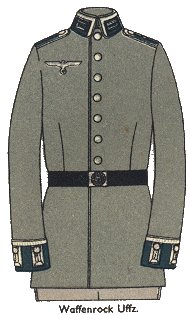
Der Waffenrock

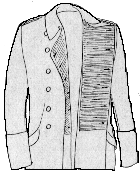
The Waffenrock is used with: Paradeanzug, Gesellschaftsanzug, Ausgehanzug  for NCO´s and men and may be used with the kleiner Dienstanzug, Meldeanzug, kleiner Gesellschaftsanzug, Ausgehanzug for officers. NCO´s and men wear the Waffenrock during duty in the garrison, Exerzierdienst, shooting-duty but not at field- and combat-training at Btl. or higher level. Officers may wear the Waffenrock for all occasions if it seems unlikely to get involved in combat. Basic-cloth: Fieldgrey/Collar and sleeves: blue-darkgreen cloth. Piping is in the Waffenfarbe. Buttons usually silver-bright metal, lightly vaulted, for generals and officials golden color buttons.

The Waffenrock of NCO´s and men have the embroidered eagle for officers (variants possible). On the shoulders men and NCO´s wear shoulder straps, officers and officials shoulder-straps. The shoulder-straps of men and NCO´s are fixed by a button with engraved arabic Kompanie-, Schwwadron- or Batterie-number; men and NCO´s of Bataillon and Abteilungsstäbe have roman numbers. Men and NCO´s of independent Bataillons-, Abteilungsstäbe, Regimentsstäbe, higher commands officers and officials wear plain buttons.

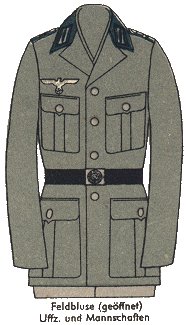
Feldbluse

Feldbluse for men and NCO´s Feldbluse officers Feldbluse men

Piped Feldbluse for officers Feldbluse for officers (left) and generals (right)
The Feldbluse is worn with the Feldanzug, Dienstanzug and may be worn with kleiner Dienstanzug, Meldeanzug, kleiner Gesellschaftsanzug, Ausgehanzug for officers. NCO´s and men wear the Feldbluse with the Ausgehanzug in the early years of the war until the unit was supplied with a Waffenrock for men and NCO´s. Basic-cloth: Feldgrau; Collar and shoulder-straps: blue-darkgreen cloth. Several versions were produced during the war (see them described later). Collar-braids: Feldgrau, embroidered; Braid-mirrors: older version in Waffenfarbe, new version all branches silver. The breast eagle is of silver-grey cotton yarn.

Generally, for NCO´s and men the collar is worn closed, but in suitable weather, and if it is convenient for the work they are doing it may be worn open. Permission to undo a button or two on a long march used to be a concession much appreciated. In future it is to be encouraged. Officers wear the Feldbluse closed but can open the collar or the top buttons if the men wear the Feldbluse open. The breast eagle is embroidered in silver aluminium thread.

Feldbluse Modell 1936: This modell was manufactured from a wool/rayon mixed material. It had four box pleated patch pockets. Five fieldgrey finished metal-buttons  were positioned down the front with another button to each of the four three pointed pocket flaps, a style of pocket adopted from those worn on the Austro-hungarian Army tunics of WWI.The collar was faced with dark blue-green material and this was also used as the backing cloth to the national emblem positioned across the right breast of the jacket and running parallel to the top of the right breast pocket. The material was also used as backing cloth of the collar patches, to trade and specialist insignia. Three reinforced belt hook eyelet holes positioned one above the other were situated  on either side of the waist in the front and at the back of the tunic. Four removable metal belt hooks could be positioned at one of the three slightly varying heights to support the wearer´s leather belt and thus the equipment hung from the belt. Shoulder-straps, constructed from dark blue-green material, were normally removable from the tunic. NCO´s Feldbluse show the visible signs of rank. These were the 0,9cm wide rank braiding worn down the front and around the lower edge of the tunic collar. The "Spiess" wore the double rings of 0,9cm braiding on both cuffs. The Feldbluse for officers was usually of better material quality and had the noticeable difference of plain, deep turnback cuffs.

Feldbluse Modell 1943: This tunic lacks the familiar dark blue-green collar material. Shoulder-straps are constructed entirely from field-grey cloth. The four pockets to this tunic no longer had box pleats and the pocket flaps were reduced slightly in depth and were cut straight without having the three points to them.

Feldbluse Modell 1944: On 25.Sept.1944 germany introduced this new style tunic because of the economic pressure. This was a complete break with german uniform tradition in so far as it was a new form of uniform jacket. The colour was more slate grey-green than fieldgrey and the most noteable feature of the field blouse was the replacement of the jacket skirt with a waist band 12cm deep. Because of the lack of a skirt to the jacket only two pockets were worn, both on the chest. Each were without pleats and each had a simple straight-edged pocket flap. The collar of the jacket, slate grey-green in colour was normally worn open but it clould be closed if required. There were six dark-grey buttons worn down the front the lower two being positioned on the waist band.The back of the jacket was made of one unseamed piece of material. There were two inside breast pockets, each closed with a single fibre button.

White tunic for officers and officials with officer rank

White tunic new-style (left) White tunic old-style (right)

The whit tunic is an accepted uniform piece. It may be worn in the garrison,on the training-ground, during riding outside of the garrison, while the soldiers wear Drillich- or Sportanzug. The new-style tunic may also be worn during special occasions on the street.

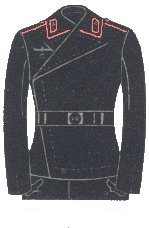
Panzerjacke

Jacket for mechanized, armoured units

For troops serving with armoured cars, tanks etc., there is a special tunicof black cloth; Beret, field-jacket and trousers fastened round the ankle. The jacket is piped in Waffenfarbe around the shoulder-straps, collar and cuff-paches - the last named showing a Death´s head in aluminium. Officers shoulder-straps are the same as with the field tunic and the eagle worn on the right breast is, for all ranks, of silver-grey cotton yarn on a black underlay.

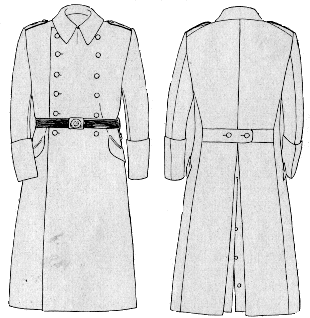
Der Mantel

Coat for men, NCO´s, officers up to Oberst and for officials

Coat for generals and officials with same rank

Basic-cloth: Fieldgrey Collar: Blue-darkgreen cloth (new-style) fieldgrey (old style), shoulder-straps for men and NCO´s rounded and piped with Waffenfarbe, shoulder-boards for officers and officials as on the Feldbluse; Buttons like on the Feldbluse; The coat has to worn closed except coats for generals and officials at the same rank. These coats have bright-red breast lining for generals, dark green for officials. The top buttons are left open to see the inner lining of the coat. The buttons on general coats are golden.

The cape: To wear a cape is allowed for officers and officials with officers rank, except with the parade-tunic and all occasions with the possibility of enemy contact.

Der Schutzmantel

Schutzmantel for Kradfahrer

Kradfahrer wear the Schutzmantel at bad weather. The coat is made of fieldgrey rubber, with shoulder-straps or shoulder-boards.

A Kradschütze with the Schutzmantel

Die Windjacke

The waterproof jacket

The Windjacke is a special uniform piece for mountain-troops. He is made of olivegreen caliko. The buttons are normal grey horn-, stonenut-style. The buttons on the shoulder-straps are the same as on the Feldbluse. The shoulder-straps are the same as on the Feldbluse. Some insignias are not applied on the Windjacke. The jacket can be worn above the belt with ammo-pouches.

A Gebirgsjäger with the Windjacke in Russia 1942

HOME        UNIFORMS-MAIN        UNIFORMS-HEER